
Most conversations about health focus on individual choices. What you eat. How much you exercise. Whether you go to the doctor. Those things matter, but they explain only a fraction of why some people are healthier than others.

Photo by Sara Cottle on Unsplash
The bigger story is about conditions. Where you live, whether you can find stable work, what schools are available to your kids, whether your neighborhood has a grocery store or a food desert, whether you feel safe walking outside. These are called social determinants of health, and research consistently shows they account for more variation in health outcomes than medical care and individual behavior combined. (WHO Commission on Social Determinants of Health, 2008)
What the Term Actually Means
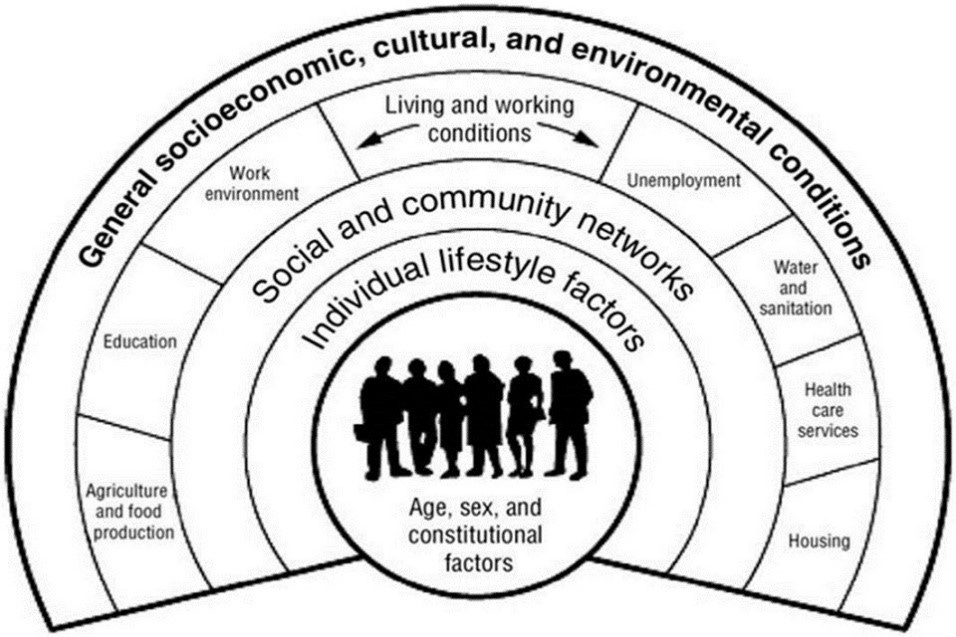
Social determinants of health are the conditions in the environments where people are born, live, learn, work, play, and age that affect a wide range of health outcomes and quality of life.
The major categories include:
Economic stability. Whether people have reliable income, stable employment, and financial security. Poverty is directly associated with higher rates of chronic disease, mental illness, and premature death.
Education. Access to quality schools and opportunities to develop skills and health literacy. Education shapes employment, income, and a person’s ability to navigate the healthcare system.
Healthcare access. Whether people can get care when they need it, afford it, and find providers nearby. Access to preventive care determines whether problems get caught early or become crises.
Neighborhood and built environment. Air quality, housing conditions, access to healthy food, safe spaces for physical activity, and exposure to violence. Two neighborhoods a few miles apart can have life expectancy differences of a decade or more.
Social and community context. Social connection, discrimination, and community support all affect health in measurable ways. Chronic social isolation, for example, is associated with mortality risk comparable to smoking. (Holt-Lunstad et al., Perspectives on Psychological Science, 2015)
Why This Matters Beyond the Individual

Understanding social determinants changes how you think about health advice. When someone struggles to eat well, it is worth asking whether they have a grocery store nearby or whether their schedule allows time to cook. When someone cannot maintain an exercise routine, it is worth asking whether they have a safe place to walk or the energy left after working multiple jobs.
This is not about removing personal responsibility. It is about recognizing that individual choices happen within systems that either support or undermine them. The most motivated person in the world faces a harder road when the environment works against them.
The practical implication is that the most effective health interventions often operate at the community and policy level — improving access to healthy food, safe housing, quality education, and healthcare — rather than telling individuals to try harder in conditions that make trying harder genuinely difficult.
A Starting Point, Not the Full Picture

This post is an introduction. If you want to go deeper on how social determinants play out in real communities — including the data on life expectancy by zip code, the drivers of health inequity, and what individuals and communities can actually do — the full exploration is here:
The Social Determinants Nobody Talks About: Why Your Zip Code Matters More Than Your Gym
·
Feb 5

Individual health advice dominates wellness culture. Eat better. Exercise more. Manage your stress. Take supplements. All the focus is on personal choices and behaviors.
The Reset Compass is designed with this reality in mind. It does not assume you have ideal circumstances or unlimited resources. It meets you where you actually are. Free to start, with a premium option available for those who want more.
Marcus Clark is the founder of Evolution of Wellness LLC and holds a Master of Public Health degree. This post is for informational purposes and does not constitute medical advice. Always consult your healthcare provider for personalized guidance.
Get posts like this in your inbox.
Every five days. Research-backed. Free.
About the Author
Marcus Clark is the founder of Evolution of Wellness LLC. He holds a Master of Public Health degree and a Lean Six Sigma Yellow Belt certification, with a background spanning clinical rehabilitation, personal training (ACE certified), healthcare administration, behavioral health program coordination, and public health research. Evolution of Wellness was built on the principle that health knowledge is always evolving, and the guidance people receive should evolve with it.
This post is for informational purposes only and does not constitute medical advice. Always consult your healthcare provider before making changes to your health routine.