
The wellness space has an information problem.
Not a shortage of information. The opposite. There is more health content being produced and distributed right now than at any point in human history. Claims about supplements, diets, sleep protocols, exercise approaches, and disease prevention spread across Instagram, TikTok, Facebook, and YouTube every single day, reaching millions of people before anyone has stopped to ask whether any of it is actually supported by research.
Most of it never gets checked. And most people have no reliable way to check it even if they wanted to.
That is not a personal failure. It is a structural one. The tools for evaluating health evidence have never been designed for a general audience.
Why Checking the Research Is Harder Than It Should Be

Working as a researcher, I had access to some of the most sophisticated databases and research tools available. PubMed. Semantic Scholar. Crossref. OpenAlex. These are the repositories where peer-reviewed science actually lives, where studies go through editorial review before publication, where findings are scrutinized by other experts in the field before anyone can claim they are credible.
But here is the thing. Even with full access to those databases, finding relevant and current research on a specific claim is not straightforward. You have to know how to construct a search query. You have to know which terms to use, which to exclude, how to filter by date and study type and methodology. Do it wrong and you either miss the most relevant research entirely or surface results that have nothing to do with what you were looking for.
If that is the experience for someone with research training, imagine what it looks like for someone who just wants to know whether the supplement their friend recommended is actually backed by science.
Why True or False Is the Wrong Framework
Here is something that gets lost in most fact-checking conversations…Most health claims are not simply true or false. They exist on a spectrum.
A claim might be strongly supported by multiple large randomized controlled trials. Or it might be supported by a handful of small observational studies with significant limitations. Or the evidence might be genuinely mixed, with some studies pointing one direction and others pointing another. Or the claim might be true in a specific population but not generalizable. Or the research might be so preliminary that drawing any conclusion at all would be premature.
Handing someone a true or false verdict on a health claim without that context is not helpful. It is actually misleading, because it implies a certainty that the research itself does not support.
What people need is not a verdict. They need a picture of where the evidence actually stands.
What EvidenceCheck Does
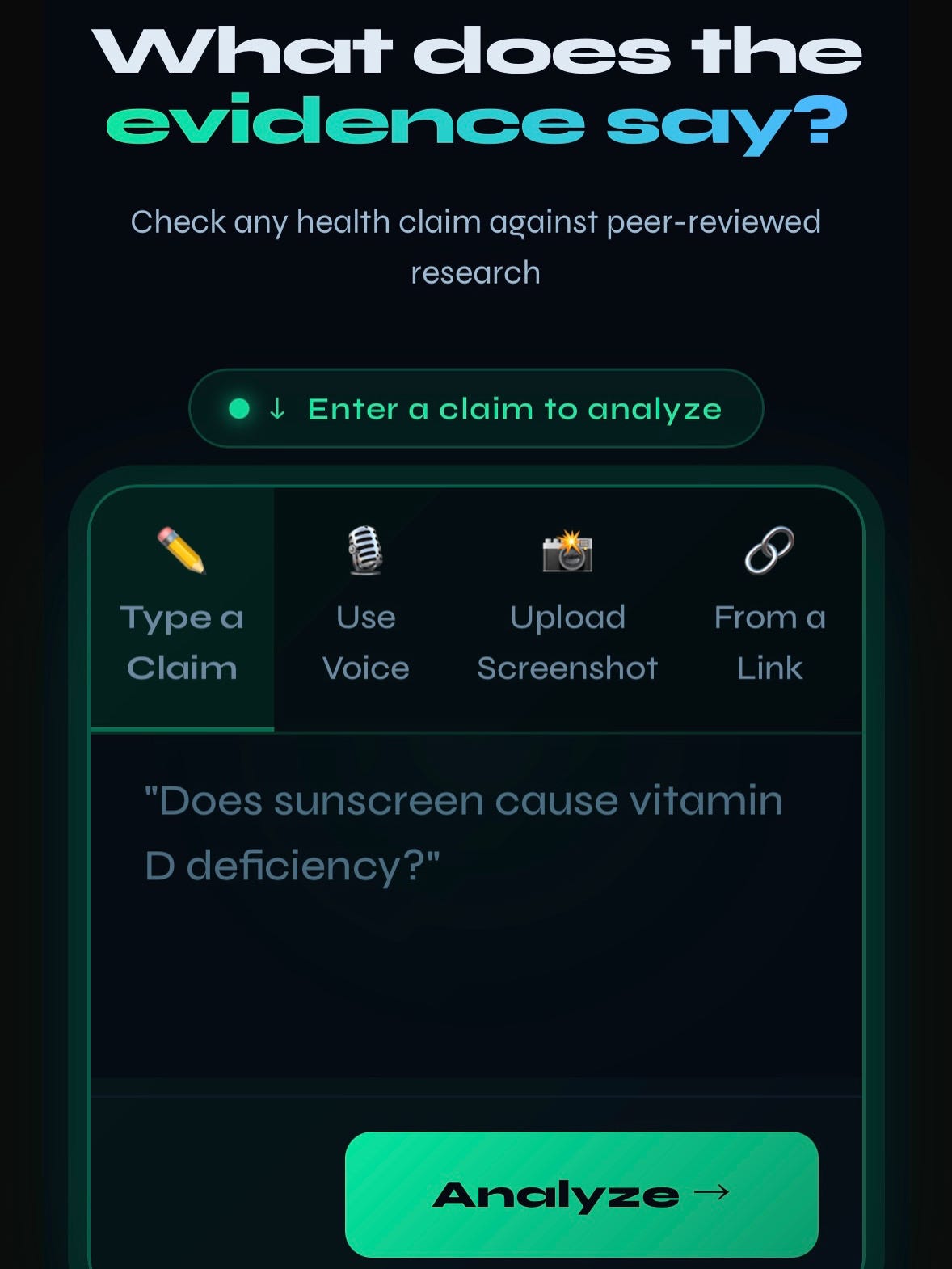
I built EvidenceCheck at evidencecheck.io to solve this specific problem.
You type in any health claim. Something you saw on social media, something a friend told you, something you read in an article. EvidenceCheck searches PubMed, Semantic Scholar, Crossref, and OpenAlex simultaneously, finds the most relevant and current peer-reviewed studies on that claim, and returns a result on a 7-level evidence spectrum rather than a binary verdict.
That spectrum runs from strongly supported to actively contradicted, with nuanced levels in between that capture where most health claims actually land. Preliminary evidence. Mixed findings. Supported in specific contexts. Still under investigation. The language is designed to reflect how science actually works rather than flattening it into a headline.
It also runs a bias check, identifying potential limitations in the research it surfaces so you are not just handed a citation and told to trust it. And critically, every finding links back to the actual source studies. Because I did not want to build something where people just trust an AI summary. I wanted to build something where people can see exactly what the tool found and verify it themselves.
That last part matters to me. The goal was never to replace critical thinking. It was to make critical thinking accessible to people who have not spent years learning how to navigate academic databases.
What This Means for You
The next time you see a health claim that seems too good to be true, or too alarming to ignore, you now have somewhere to take it.
Not a Google search that returns whoever paid most for SEO. Not a social media comment section. Not an AI chatbot trained to sound confident regardless of evidence quality.
A tool that searches actual peer-reviewed research, shows you where the evidence stands on a spectrum, tells you the limitations of that evidence, and gives you the sources to verify everything yourself.
That is a different category of tool entirely. And it is free to use.
EvidenceCheck is live right now at evidencecheck.io
Go check a claim you have been wondering about. See what the research actually shows…
If you want to take one action toward your health today based on where you actually are right now, The Reset Compass is also free and requires nothing except honesty about how you feel.
Try The Reset Compass for Free
You deserve accurate health information. Now you have a tool built to give it to you.
About the Author
Marcus Clark is the founder of Evolution of Wellness LLC and holds a Master of Public Health degree. He has a background in physical therapy and personal training with a focus on chronic disease prevention. Evolution of Wellness was built on the principle that health knowledge is always evolving, and the guidance people receive should evolve with it.
Marcus Clark is the founder of Evolution of Wellness LLC and holds a Master of Public Health degree. This post is for informational purposes and does not constitute medical advice. Always consult your healthcare provider for personalized guidance.
Get posts like this in your inbox.
Every five days. Research-backed. Free.
About the Author
Marcus Clark is the founder of Evolution of Wellness LLC. He holds a Master of Public Health degree and a Lean Six Sigma Yellow Belt certification, with a background spanning clinical rehabilitation, personal training (ACE certified), healthcare administration, behavioral health program coordination, and public health research. Evolution of Wellness was built on the principle that health knowledge is always evolving, and the guidance people receive should evolve with it.
This post is for informational purposes only and does not constitute medical advice. Always consult your healthcare provider before making changes to your health routine.